Audit and optimize a multi-agent fleet for performance and cost
What it does
Runs a full-stack audit across your Hermes agents and subagents, measuring turn latency, context size, and token usage. Identifies bloat sources like unused skills, oversized system prompts, heavy MCP tool catalogs, and stale memory.
Applies targeted optimizations: compresses prompts, disables unused tools, routes background workers to efficient models, and archives old memory. Remeasures performance and reports before/after improvements.
Why it's worth it
Multi-agent systems accumulate hidden costs over time: unused features, bloated configurations, and stale memory that slow responses and inflate token bills.
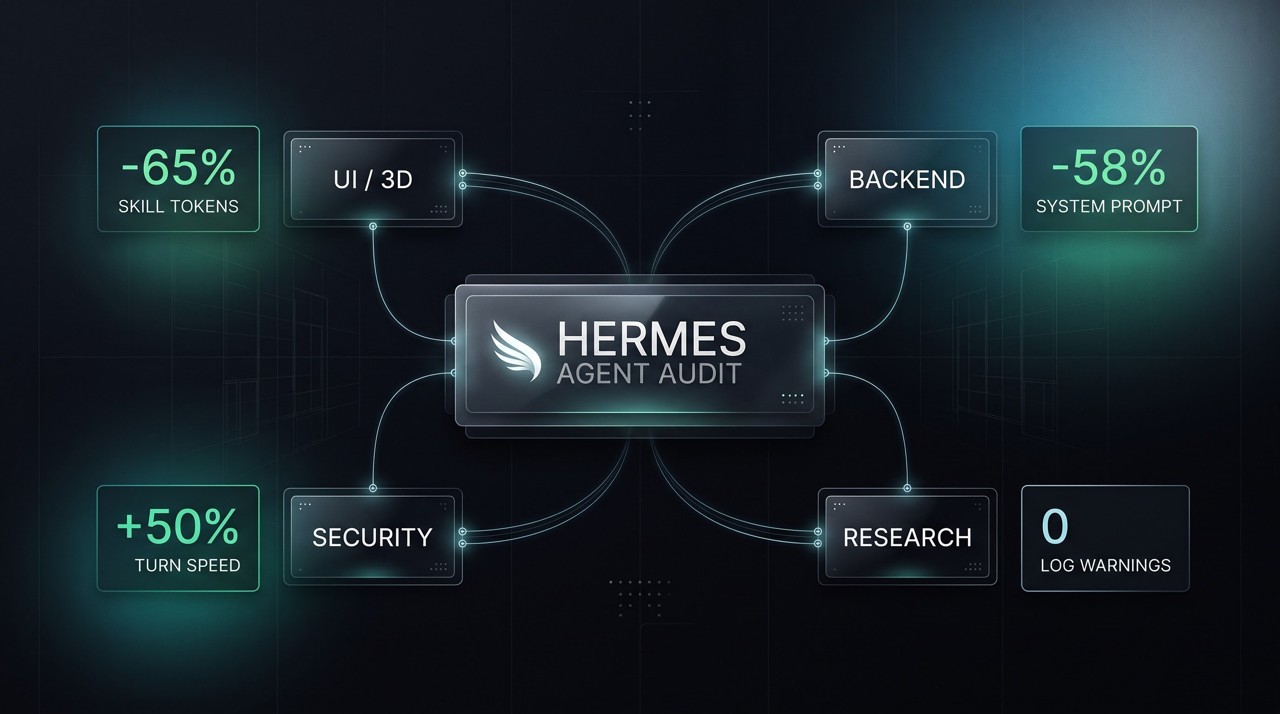
An audit reveals which optimizations yield the biggest wins. A well-tuned fleet responds 50% faster, uses 70% less context, and reclaims gigabytes of disk.
Step by step
Paste it into Hermes Agent and swap the highlighted parts for your own details.
Get Hermes Agent to:
- Audit my agents and subagents: list each agent profile, system prompt size in tokens, active skills, and enabled MCP tool catalogs.
- Measure current performance: run [10] sample turns across [my main agent] and [3 key subagents], recording turn latency, context size, and tokens used.
- Identify bloat sources: find unused skills that don't match [my typical workflows], system prompts that can be compressed, MCP tools adding overhead, and memory entries older than [60 days].
- Optimize each bloat source: disable unused skills, compress system prompts to [target size], disable redundant MCP catalogs, archive stale memory.
- Test the improvements: run the same [10 sample turns], record new latency and token metrics, calculate improvement vs. baseline.
- Generate an optimization report: show before/after metrics for latency, context size, tokens per turn, and disk reclaimed.
- Present optimizations for my approval: list each change and its impact before applying to my production profiles.
- Apply changes and document: update my agent configurations with approved optimizations and note the audit date.
Expected resultA multi-agent fleet responding 50% faster with 70% less context bloat, lower token costs, and 2.5 GB of reclaimed disk space.